

How politics, debt and refinancing costs are reshaping French bonds
A government does not need to default to face a rising cost of financial credibility. Sometimes, the warning appears much earlier, for instance in the price investors demand to hold its debt.
France is experiencing precisely this kind of pressure.
On 3 November 2026, the yield on France’s 10-year government bond stood at 4.94%, approximately 163 basis points above the German Bund. No doubt, the difference is very significant, prompting investors to demand an additional 1.63 percentage points to lend to France rather than Germany over a comparable maturity.
The spread has reached a level not seen since the euro-area sovereign debt crisis, according to the French economic research institute OFCE.
Uniquely, France and Germany share a currency, a central bank and a common monetary framework. Yet the cost of financing their governments has moved materially apart.
The question is not simply why French government debt is yielding more. It is what the widening premium tells us about the market’s assessment of France’s fiscal trajectory, and how much that assessment could eventually cost the French taxpayer in the long run.
A European bond-market repricing with France at its centre
It would be misleading to interpret the rise in French borrowing costs entirely in isolation. Sovereign yields have increased across several advanced economies, including the United States amid changing inflation expectations, energy-market developments and uncertainty about the future path of monetary policy.
The German Bund has not been immune to these movements at well. Its yield has also risen.
But the relative performance of French government bonds is what makes the current episode particularly important.
Because following the dissolution of the French National Assembly in June 2024, the OAT–Bund spread moved higher and became more volatile. OFCE puts the average spread during the 2022–2024 parliamentary term at approximately 53 basis points. After the dissolution, it rose to around 80 basis points and subsequently widened further.
And by 3 November 2026, it had reached 163 basis points.
The movement suggests one thing – that investors are demanding more compensation to hold French government debt than they did before the political disruption of 2024.
Such a spread is often described as a sovereign risk premium. Well, in itself, that description is useful, but it should not be interpreted too narrowly. The difference between French and German yields also reflects liquidity, relative bond supply, investor positioning, term premia and the particular characteristics of each sovereign market.
Nevertheless, when the spread widens persistently, it becomes an important measure of the market’s changing assessment of France relative to Germany.
The fiscal arithmetic is becoming harder to ignore
France’s fiscal position provides an important part of the explanation.
The European Commission’s Spring 2026 Economic Forecast projected that France’s general government deficit would remain at 5.1% of GDP in 2026 before increasing to 5.7% in 2027, assuming unchanged policies.
Over the same period, public debt was projected to rise from 115.6% of GDP in 2025 to 118.1% in 2026 and 120.2% in 2027.
Understandably, the French government’s position is different because it is based on a proposed programme of fiscal adjustment. Following the deterioration in the 2026 outlook, the government revised its deficit estimate for that year to 5.4% of GDP and set a target of 5.0% for 2027.
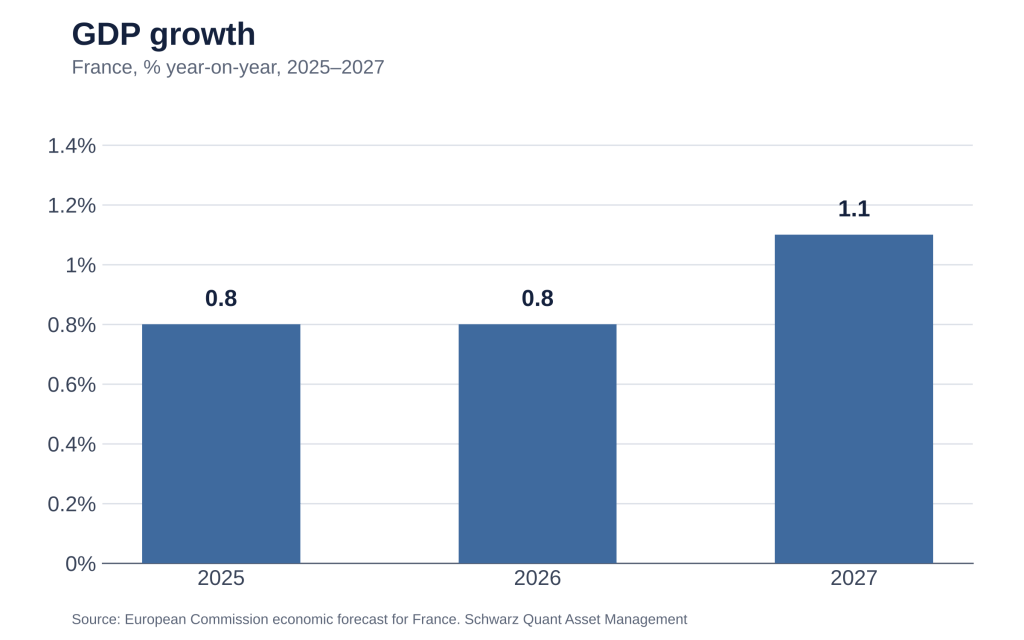
Should we treat these figures as competing forecasts of an identical scenario? Maybe not. Because the Commission’s projections assume unchanged policies, while the government’s 2027 figure is a policy target that depends on the adoption and implementation of proposed budgetary measures.
As a matter of fact, that distinction matters to bond investors a lot.
Because a government can announce a deficit-reduction target, but it’s up to the market to assess whether the measures required to achieve it are politically feasible, economically sustainable and sufficiently detailed to be credible.
France faces a difficult combination here – with a large existing debt stock, persistent budget deficits, relatively weak growth and a political environment in which agreement on fiscal adjustment has become increasingly difficult.
The problem is not simply the size of the deficit in one particular year. It is the difficulty of establishing a credible path towards stabilizing public debt.
Political risk is becoming a credit consideration
The political dimension is now reflected in the assessments of the major credit rating agencies.
For instance, on 23 October, Moody’s maintained France’s Aa3 rating[1] but retained a negative outlook. The agency’s position reflects concerns about the country’s fiscal trajectory and the ability of the political system to deliver sustained deficit reduction.
On 30 October, Fitch affirmed France at A+ but revised its outlook from stable to negative[2]. Its assessment cited weaker growth, higher borrowing costs, a wider deficit and political fragmentation as factors complicating fiscal consolidation.
Standard & Poor’s maintained an A+ rating[1] with a stable outlook, with its next scheduled review listed by Agence France Trésor for 27 November 2026.

The different ratings and outlooks illustrate that sovereign credit analysis is not a mechanical exercise. Meaning agencies can agree that fiscal risks are increasing while reaching different conclusions about the severity and timing of those risks.
For sure, France retains substantial credit strengths because of it large and diversified economy, established institutions, access to deep capital markets and membership of the euro area.
Those strengths matter a lot. Please do not get me wrong, a widening spread does not mean that France is about to lose access to market financing.
But a country’s credit standing is not determined by its economic size alone. Investors also assess the government’s capacity to respond when fiscal pressures increase.
Like I mentioned earlier, the central question for France is whether its institutions can translate announced fiscal objectives into a durable and politically sustainable budgetary framework.
From the bond market to the public budget – how the spread becomes a cost
The most important part of the current debate is not necessarily the level of the spread itself. It is how that spread eventually affects the government’s interest bill.
A government bond yield observed in the secondary market does not immediately change the coupon paid on every outstanding bond.
An existing fixed-rate French government bond continues to pay the interest specified when it was issued. The government does not suddenly pay a higher coupon because the market price of that bond has fallen.
The transmission takes place as debt matures and the Treasury issues new securities to refinance it, or raises additional financing to cover budget deficits.
As a result, the speed at which higher market yields affect public finances depends heavily on the maturity structure of government debt and the Treasury’s issuance strategy.
This is particularly important in France, where the average maturity of the negotiable state debt was approximately eight years and 139 days at the end of October 2026, according to Agence France Trésor.
The maturity structure provides a degree of protection against immediate market shocks. It also means that an elevated borrowing premium can become a persistent cost if it remains in place for several years.
What does 163 basis points actually cost France?
A study published by OFCE on 5 November 2026 by Raul Sampognaro[4] provides a useful quantitative assessment.
Using the structure of France’s negotiable government debt and the market conditions examined in the study, OFCE estimates that the outstanding debt stock generates an annual interest charge of approximately €61.4 billion, corresponding to an average apparent interest rate of 2.10%.
The researchers then simulate how that interest charge evolves as existing securities mature and are replaced by new borrowing.
Under the French financing conditions used in the simulation, the annualised interest charge on the debt stock would reach approximately €78.8 billion by December 2027.
Under a hypothetical scenario in which France could refinance at German borrowing rates, the corresponding charge would be approximately €71.4 billion.
The difference is €7.4 billion.
This is the estimated annualised cost attributable to the France–Germany sovereign yield differential under the assumptions of the OFCE model. It represents approximately 0.2% of GDP.
Extending the simulation to December 2028, OFCE estimates that the spread-related difference could reach €13.2 billion, equivalent to approximately 0.4% of GDP.
It’s very reasonable that the 2028 calculation assumes a substantial improvement in the French deficit, in line with the government’s medium-term adjustment plan.
These figures deserve careful interpretation though. They are not immediate cash payments, nor do they represent the total increase in France’s interest expenditure. They are modelled annualized interest charges applied to the debt stock at the specified dates, comparing French financing conditions with a hypothetical German-rate refinancing scenario.
The distinction is important because the total interest bill is also affected by the volume of debt, general movements in interest rates, inflation-linked securities and the government’s financing requirements.
Nevertheless, the implication is difficult to ignore because a persistent sovereign yield premium can become a material additional burden on public finances.
How Higher Borrowing Costs Work Their Way Through Public Debt
The maturity profile of French debt explains why the full effect of higher borrowing costs takes time to emerge.
OFCE estimates that approximately 15% of the negotiable debt stock would have been refinanced after one year, around 73% after ten years and approximately 90% after twenty years, under its rollover assumptions.[5]
The corresponding apparent interest rate on the debt stock would rise from 2.10% to approximately 2.40% after one year, 4.17% after ten years and 4.61% after twenty years.
These figures illustrate the gradual transmission of market rates into government expenditure. They are not forecasts of the future market yield on French bonds. They are modelled results based on the assumed refinancing conditions.
The immediate effect of a widening spread can therefore appear relatively manageable. The longer-term effect can be much more consequential.
This is one reason why the current French situation deserves attention beyond the next budget vote.
A temporary increase in borrowing costs may have a limited effect if market confidence recovers quickly. A premium that persists over several refinancing cycles can progressively alter the government’s interest expenditure and reduce the room available for other budgetary priorities.
The interaction between borrowing costs, nominal growth and primary deficits will determine whether France can stabilise its public debt.
The relationship between interest rates, economic growth and public debt is often described through the debt snowball effect.
In simplified terms, when the effective interest rate on government debt exceeds the nominal growth rate of the economy, the existing debt burden tends to increase relative to GDP unless the government generates a sufficient primary surplus.
The reverse can also be true. When nominal economic growth exceeds the effective interest rate, the debt ratio can become easier to stabilize, although the primary fiscal balance still matters.
The OFCE simulation offers an important qualification to the current debate.
Its estimated apparent interest rate of approximately 2.52% at the end of 2027 remains below its estimate of nominal potential growth of around 3.2%.
On those assumptions, the interest-rate-growth differential is not yet the principal driver of France’s projected debt dynamics in 2027.
The larger immediate problem is the persistence of primary deficits – the government continues to spend more than it collects before accounting for interest payments.
This distinction is also important. It would be inaccurate to suggest that the current spread alone is driving France towards a debt crisis.
The more relevant concern now is the interaction between persistent primary deficits, rising refinancing costs and weak economic growth. If these conditions continue, the favorable relationship between nominal growth and the effective interest rate could become less supportive over time.
The spread is therefore one part of a wider fiscal equation, not the entire explanation.
The term structure of France’s sovereign risk premium
The level of the 10-year spread attracts attention, but the distribution of the premium across maturities offers additional insight into how investors are pricing French sovereign debt.
Cbonds data for 9 November 2026 show a widening differential across the maturity spectrum, from 19.3 basis points at three months to 164.6 basis points at thirty years. The two-year spread stood at 49.5 basis points, the five-year at 103.5 basis points and the ten-year at 147.4 basis points.
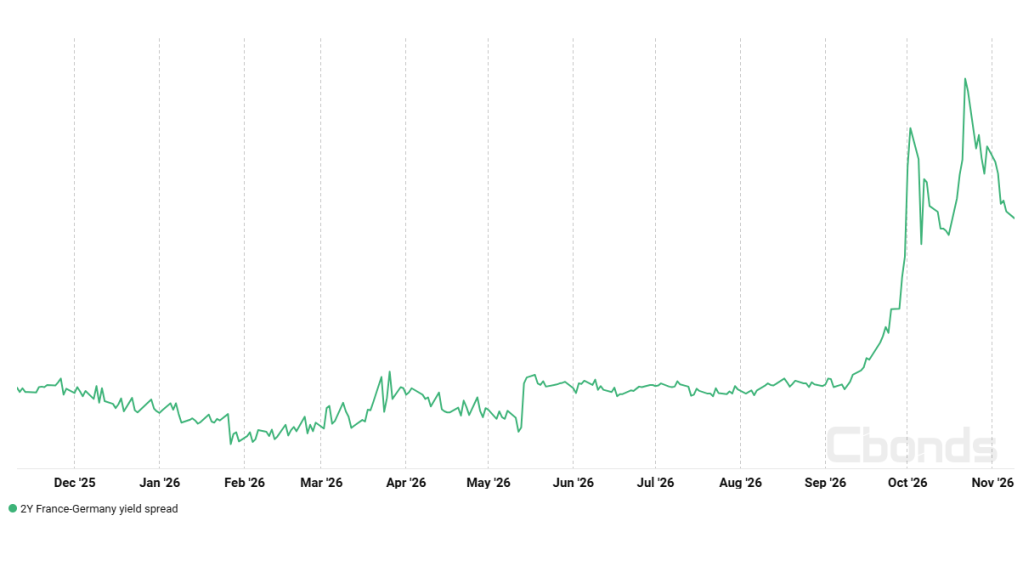


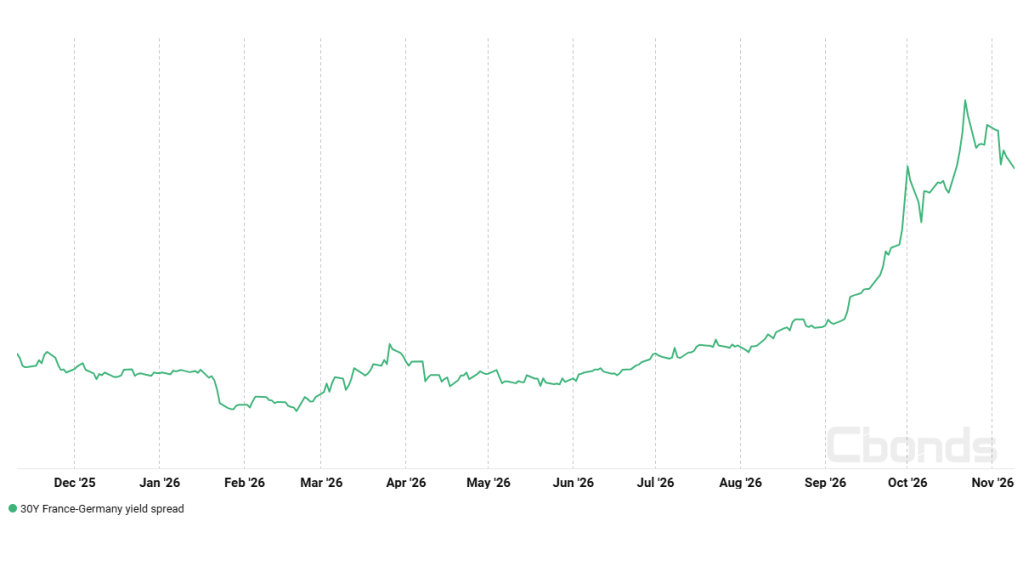
The pattern suggests that the additional compensation demanded by investors increases with the maturity of the bonds. In other words, the premium attached to French government debt is not confined to the immediate budget horizon.
There has, however, been some moderation. Compared with 29 October, spreads at the two-, five-, ten- and thirty-year maturities had narrowed by approximately eight basis points, while the three-month spread had edged higher.[6]
This is an important distinction. The longer-dated premium remains substantial, but its recent movement does not point to a continuous deterioration across the entire yield curve.
One possible interpretation is that investors remain concerned about the durability of France’s fiscal adjustment over a longer horizon. However, the shape of the curve is not conclusive evidence of structural sovereign repricing. Differences in liquidity, bond supply, term premia and duration exposure can also influence spreads at different maturities.
The more useful question is whether the long-dated premium remains elevated as the political and fiscal outlook becomes clearer.
For investors, the term structure is still worth monitoring alongside the headline 10-year spread.
The feedback mechanism — and why it has limits
There is a potential feedback mechanism between political uncertainty and sovereign financing costs.
Definitely, any uncertainty about the budget can increase the compensation investors demand to hold government debt. As it were, higher refinancing costs gradually increase interest expenditure. A larger interest bill leaves less room for public investment, social expenditure or tax relief.
At the same time, the measures required to reduce the deficit may weigh on economic activity if they are poorly designed or implemented during a period of weak growth.
Lower growth can, in turn, make debt stabilization extremely difficult.
This is not an automatic or inevitable spiral. France continues to have access to the government bond market, and its institutional and economic strengths remain significant.
The distinction between a period of elevated sovereign risk premia and a genuine funding crisis is essential.
The market can demand a higher price for French debt without refusing to finance the French state.
Nevertheless, the longer the premium persists, the more important its cumulative effect becomes.
What investors should watch

The direction of the French sovereign risk premium will depend on more than the next movement in bond yields. Several developments deserve particular attention.
- The credibility of fiscal adjustment
The 2027 budget process will be an important test. Investors will want to see whether the government can secure parliamentary support for measures that deliver meaningful and credible deficit reduction. Announced targets matter, but the ability to implement them matters more.
- Rating decisions and market access
Standard & Poor’s next scheduled review of France is listed for 27 November 2026. Any further rating action by the major agencies could affect investor perceptions, borrowing conditions and the investment mandates under which some institutions hold sovereign debt.
- Government borrowing and refinancing
The Agence France Trésor’s 2027 financing programme will provide important information about the volume and maturity structure of new government borrowing. The pace at which existing debt is refinanced at higher market rates will determine how quickly the current premium feeds into public expenditure.
- The shape of the sovereign spread curve
The OAT–Bund spread should be monitored across maturities, not just at the ten-year point. A sustained narrowing at the longer end could
indicate improving confidence in France’s medium- and long-term fiscal outlook. However, movements in German yields and broader euro-area bond markets must also be taken into account.
- France’s position relative to other euro-area issuers
The France–Italy yield differential offers another useful perspective. It helps investors assess whether market concerns are becoming more specific to France or reflect a broader reassessment of sovereign risk across the euro area.
- What is actually driving spread compression?
Perhaps most importantly, investors should distinguish between a genuine improvement in France’s fiscal credibility and a narrowing spread caused by a general decline in European government bond yields. The two developments may produce a similar movement in the headline spread, but they do not carry the same implications for investment risk.
Our perspective – where we see value in the French case
Markets tend to fixate on the next headline. Will the budget pass? Will the spread widen again? We think the more useful question is a slower one: can France persuade investors that its public finances are on a credible path, and will its actions match its promises?
Political noise fades. Confidence in the public finances is harder to rebuild, and it is rebuilt through evidence rather than statements. That is why we look past the daily move in the OAT–Bund spread to what sits underneath it – how higher borrowing costs flow into interest payments, how primary deficits develop, and how the market prices the refinancing of existing debt.
This is also where we see opportunity. Uncertainty makes prices overshoot in both directions. Comparable assets drift apart, and some risks end up priced too harshly while others are barely priced at all. We don’t treat volatility as a signal to buy, and we don’t treat a high yield as a reason to invest. What matters is understanding why a price has moved, whether the market’s judgement is justified, and what would change it.
At Schwarz Quant, we answer those questions with quantitative research, economic analysis and disciplined risk management. Our aim is not to predict every swing. It is to find mispricings, size the risk honestly, and position capital where the potential return justifies that risk. We bring the same approach to sovereign bonds, equities, commodities and alternative assets, with the goal of building long-term value for our investors across different market conditions.
We also believe investors deserve a partner who is honest, rigorous, transparent and independent in its thinking, one who questions consensus and is willing to show its reasoning. That is the standard we hold ourselves to. That is what defines us.
If you share that conviction, we invite you to stand with us.
Follow our research, please challenge our views, and join us as we build a firm where careful analysis, accountability and long-term discipline come first. Some of the most compelling opportunities appear when conventional assumptions are being questioned and careful analysis matters most, and we intend to be ready for them.
Samuel Akinkunmi Lawrence Olaogun
Learn more: schwarzquant.com Who We Are What We Do Our Audience Insights and News
Sources and attribution
[1]https://ratings.moodys.com/ratings-news/434553?gsid=8b690a32-5717-4545-9a69-d84b4d4e8f91
[2]https://www.fitchratings.com/research/sovereigns/fitch-affirms-france-at-a-outlook-stable-28-08-2026
[3] https://www.spglobal.com/ratings/en/regulatory/article/-/view/type/HTML/id/3293262
[4] https://www.ofce.fr/blog2024/fr/2026/20261105_RS/
[5] https://www.ofce.fr/blog2024/fr/2026/20261105_RS/
- OFCE — Raul Sampognaro (5 November 2026). Quel est le coût pour les finances publiques du spread de taux souverains entre la France et l’Allemagne? This is the principal source for the 163bp observation, the €7.4bn and €13.2bn estimates, and the debt-refinancing analysis. The publication is licensed under CC BY 4.0. Read the OFCE study. (https://www.ofce.fr/blog2024/fr/2026/20261105_RS/)
- OFCE — Mathieu Plane and Pierre Madec (20 October 2026). L’évolution du spread de la France au gré des évènements politico-économiques. Useful historical context for the spread. Read the OFCE analysis (https://www.ofce.fr/blog2024/fr/2026/20261020_mp_eg/)
- European Commission (21 May 2026). Economic Forecast for France. Source for the unchanged-policy deficit and debt projections. Read the Commission forecast (https://economy-finance.ec.europa.eu/economic-surveillance-eu-member-states/country-pages-including-country-reports/france/economic-forecast-france_en?prefLang=ro)
- Agence France Trésor. The State Budget and France’s Credit Ratings. Sources for the 2027 financing programme and rating-agency calendar. 2027 financing information · Credit ratings. (https://www.aft.gouv.fr/en/frances-credit-ratings)
- Direction générale du Trésor (6 October 2026). Rapport relatif aux mesures prises dans le cadre du mécanisme de correction 2027. Read the government report. (https://www.tresor.economie.gouv.fr/Articles/2026/10/06/le-rapport-relatif-aux-mesures-prises-dans-le-cadre-du-mecanisme-de-correction-2027-est-publie?)
- LSEG (October 2026). How do you like your OATs? Useful independent market context and comparison of European sovereign spreads. Read the LSEG analysis (https://www.lseg.com/en/insights/ftse-russell/how-do-you-like-your-oats?)
- Reuters (30 October 2026). Fitch’s revision of France’s outlook to negative. Read the rating-agency report. (https://www.reuters.com/world/europe/fitch-revises-frances-outlook-negative-worsening-debt-dynamics-2026-10-30/)